Chapter 4
The Symphony Beneath the Surface
As our bubble continues its oceanic journey, it begins to notice something that has been present all along but only now comes into conscious awareness: beneath every movement, every membrane adjustment, every relational encounter, there is a constant symphony playing—a complex orchestration of internal states that shapes every aspect of its experience.
This is the Nervous System Orchestra—an intricate ensemble of different response patterns that has been conducting the bubble's dance through both desert and ocean since the very beginning of its journey. Like a masterful symphony, this internal orchestra creates the emotional and energetic foundation upon which all authentic movement and relational capacity rests.
The Three-Part Symphony
The bubble discovers that its nervous system orchestra is composed of three primary sections, each with its own instruments, rhythms, and purposes. These sections don't play in isolation but create a complex, ever-changing composition that responds to internal states and external conditions with remarkable sophistication.
Sympathetic
Parasympathetic
Dorsal Vagal
The Sympathetic Section: The Strings of Activation
The first section our bubble learns to identify is the Sympathetic Orchestra—the strings section of its internal symphony. When this section plays, the bubble's entire being resonates with qualities of activation, alertness, and mobilization.
In sympathetic states, the bubble's membrane becomes more responsive and its movement more focused and directed. Heart rate increases, energy mobilizes, attention sharpens. This is the orchestra section that enables the bubble to surf large waves, navigate turbulent currents, and engage dynamically with challenging relational encounters.
The bubble learns to recognize different sympathetic compositions:
The Excitement Concerto: When approaching potential connection or adventure, the sympathetic strings play with bright, ascending melodies. The membrane becomes optimally permeable, movement becomes fluid and confident, and the bubble radiates an invitation to engage.
The Vigilance March: When potential threat is detected, the sympathetic section shifts to more percussive, staccato rhythms. The membrane tightens strategically, movement becomes precise and ready, scanning for danger while maintaining the capacity for rapid response.
The Overwhelm Crescendo: When activation exceeds the bubble's capacity to process, the sympathetic orchestra can become cacophonous—too many instruments playing at once, melodies competing rather than harmonizing. The membrane may become hypervigilant, movement erratic, internal experience chaotic.
The Parasympathetic Section: The Winds of Connection
The second major section is the Parasympathetic Orchestra—the wind instruments of the nervous system symphony. When this section predominates, the bubble experiences states of connection, restoration, and what researchers call "social engagement."
In parasympathetic states, the bubble's membrane achieves optimal flexibility—strong enough to maintain integrity, permeable enough to allow genuine intimacy. Movement becomes flowing and graceful, internal experience calm and spacious. This is the neurological foundation for all authentic relating, creative expression, and restorative activities.
The parasympathetic winds play various compositions:
The Safety Serenade: In genuinely safe environments with trustworthy others, the parasympathetic winds create gentle, harmonious melodies. The membrane becomes optimally permeable, movement synchronized with others, facial expressions (if bubbles had faces) soft and inviting.
The Intimacy Waltz: In moments of deep connection, the parasympathetic section creates slow, flowing compositions that allow for vulnerability and authentic sharing. The membrane becomes selectively permeable, allowing deep currents of connection while maintaining essential boundaries.
The Restoration Lullaby: During periods of solitude or gentle self-care, the parasympathetic winds play soothing, regenerative melodies. Movement becomes minimal and nourishing, the membrane settles into patterns that support healing and integration.
The Dorsal Vagal Section: The Percussion of Conservation
The third section is the most ancient and fundamental: the Dorsal Vagal Orchestra—the deep percussion that underlies all other nervous system activity. This section plays the rhythms of conservation, withdrawal, and what researchers call "immobilization."
When dorsal vagal states predominate, the bubble's movement slows dramatically or stops entirely, the membrane becomes minimally permeable, and the overall system shifts into conservation mode. This is not pathology but profound wisdom—the nervous system's recognition that sometimes the most intelligent response to overwhelm or threat is strategic withdrawal and energy conservation.
The dorsal vagal percussion plays several essential rhythms:
The Hibernation Pulse: During times of depletion or when resources are scarce, the dorsal vagal drums create slow, steady rhythms that support deep rest and regeneration. The bubble's movement becomes minimal, the membrane protectively thickened, internal processes focused entirely on conservation and restoration.
The Shutdown Silence: When threat exceeds the capacity for either fight/flight (sympathetic) or social engagement (parasympathetic), the dorsal vagal section creates strategic silence. Movement ceases, the membrane becomes nearly impermeable, and the bubble enters a state of protective numbness that allows it to survive overwhelming experiences.
The Depths Meditation: In the deepest, most pressurized waters of the ocean, the dorsal vagal percussion creates rhythms that allow the bubble to withstand extreme conditions. This is not shutdown but rather a profound state of conservation that maintains essential life functions while minimizing energy expenditure.
The Conductor's Baton: The Vagus Nerve
Our bubble discovers that orchestrating this complex three-part symphony is a sophisticated conductor: the Vagus Nerve—a neural pathway that connects the bubble's core processing center with all its peripheral systems, including the membrane, movement apparatus, and relational sensing equipment.
The vagus nerve conductor is constantly reading internal and external conditions, adjusting which section of the orchestra predominates based on moment-to-moment assessments of safety, threat, connection opportunity, and resource availability. This conductor doesn't make these decisions consciously—the assessments happen below the threshold of awareness, based on incredibly subtle cues that the bubble's sensing apparatus detects and processes instantaneously.
The bubble learns that this conductor operates according to what researchers call neuroception—the subconscious detection of safety or threat that happens before conscious awareness. The membrane's permeability, the quality of movement, the capacity for connection or withdrawal—all are orchestrated by this ancient conductor responding to neurological assessments of what each moment requires for optimal survival and thriving.
Co-Regulation: The Chamber Music of Relationship
As our bubble encounters others in the oceanic realm, it discovers something remarkable: when two or more bubbles come into proximity, their individual nervous system orchestras begin to influence each other, creating what researchers call co-regulation—a kind of chamber music where individual orchestras synchronize and harmonize.
When a bubble with a well-regulated nervous system orchestra (balanced activation, available parasympathetic capacity, functional dorsal vagal wisdom) encounters another bubble in distress, the regulated bubble's orchestra can actually help tune the dysregulated one. The steady rhythms and harmonious melodies of a regulated nervous system provide what researchers call "borrowed regulation"—the stressed bubble's orchestra gradually entrains to the calmer patterns.
Conversely, when bubbles with dysregulated orchestras encounter each other, they can create discordant compositions—sympathetic activation triggering more sympathetic activation, dorsal vagal shutdown spreading like a contagion of numbness, parasympathetic collapse creating mutual overwhelm.
The bubble learns that skillful relating requires what we might call orchestral awareness—the capacity to sense not only one's own nervous system state but also the orchestral compositions of others, and to make conscious choices about how to influence the shared musical field.
The Trauma Compositions
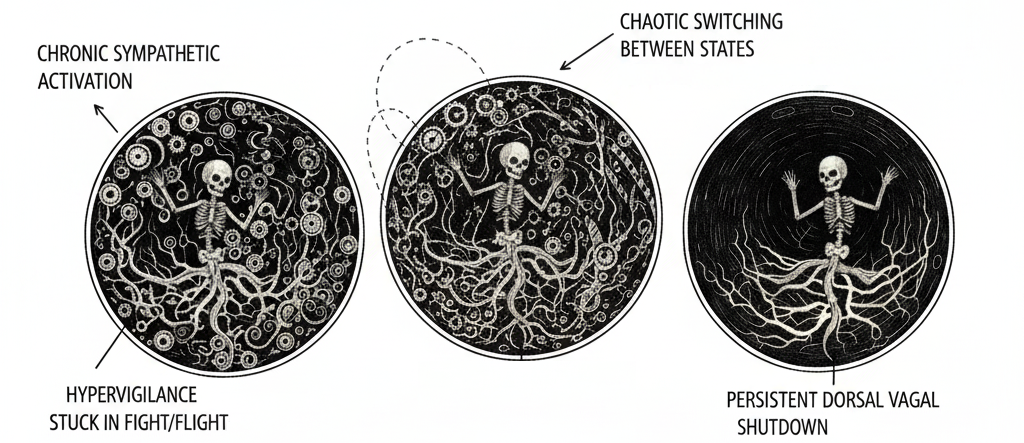
In certain deep waters of the ocean, our bubble encounters compositions that reflect what happens when the nervous system orchestra has been overwhelmed beyond its capacity to process and integrate. These are the Trauma Compositions—stuck patterns where the orchestra plays the same pieces over and over, unable to shift into new melodies even when conditions change.
Trauma compositions might manifest as:
Chronic sympathetic activation (hypervigilance compositions that play even in safe waters)
Persistent dorsal vagal shutdown (hibernation rhythms that continue even when resources are abundant)
Chaotic switching between states (discordant compositions where different orchestra sections compete rather than harmonize)
The bubble learns that healing trauma involves gradually expanding the orchestra's repertoire—adding new compositions, practicing transitions between different states, and developing the conductor's capacity to assess current conditions accurately rather than responding to historical experiences.
The Integration Symphony
As the concert concludes, our bubble achieves a new level of orchestral sophistication: the capacity to consciously participate in its own nervous system symphony. Rather than being unconsciously controlled by autonomic responses, the bubble develops what we might call nervous system literacy—the ability to recognize different orchestral compositions and make conscious choices about how to work with them.
This doesn't mean controlling the nervous system (which would be both impossible and unwise), but rather developing a collaborative relationship with the conductor and orchestra sections. The bubble learns to:
Recognize early signs of different nervous system states
Create conditions that support optimal orchestral performance
Work skillfully with activation, connection, and conservation states
Facilitate co-regulation in relational encounters
Distinguish between current orchestral needs and historical compositions
The Membrane-Orchestra Dance
The bubble realizes that its membrane—that boundary between self and world that has been evolving throughout its journey—is intimately connected to its nervous system orchestra. The membrane's permeability, thickness, and responsiveness are all expressions of the current orchestral composition.
In sympathetic states, the membrane becomes strategically responsive—more permeable to opportunity, less permeable to threat. In parasympathetic states, the membrane achieves optimal flexibility for authentic connection. In dorsal vagal states, the membrane provides maximum protection while maintaining essential life functions.
This integration of membrane wisdom and orchestral awareness prepares our bubble for its next evolutionary challenge: learning to create and maintain healthy boundaries in the fluid, ever-changing environment of relationship—boundaries that serve both autonomy and connection, protection and intimacy.